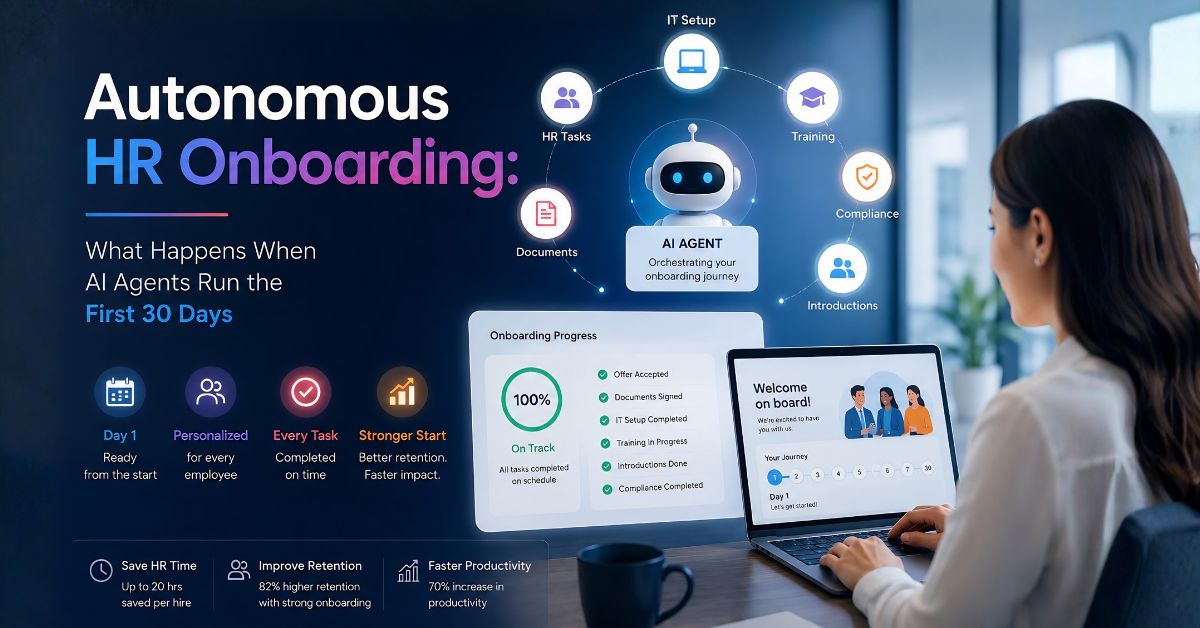
The first 30 days of an employee’s journey define everything that follows. Research from the Brandon Hall Group found that organizations with strong onboarding improve new hire retention by 82% and productivity by over 70%. Yet for most enterprises, onboarding is still an improvised sequence of emails, calendar invites, PDF handbooks, and IT tickets that somehow need to arrive in the right order, to the right person, at exactly the right time.
They rarely do.
The result is a new hire who spends their first week chasing access, their second week navigating tools no one properly explained, and their third week wondering if they made the right career move. By week four, the disillusionment that drives early attrition has already taken root.
Agentic AI changes this. Not by digitizing the checklist, but by running the entire onboarding operation autonomously, adapting in real time to each individual, and ensuring nothing falls through the cracks regardless of how complex the enterprise environment is.
Why Traditional Onboarding Keeps Failing at Scale
Before examining what AI agents do, it is worth being precise about what they are replacing.
Enterprise onboarding typically involves HR coordinators manually triggering actions across disconnected systems: an HRIS for records, an IT ticketing system for access, a payroll platform for compensation setup, a learning management system for training, and Slack or Teams for communication. Each system has its own workflow logic. None of them talk to each other natively. Coordination happens through human judgment, calendar reminders, and spreadsheets.
This model has a structural ceiling. A single HR coordinator can manage perhaps 10 to 15 onboarding journeys simultaneously before quality degrades. In high-growth periods, enterprises routinely bring on 50 or 100 new hires in a single month, across multiple geographies, roles, and departments. The arithmetic does not work.
Three failure patterns repeat across almost every large-scale onboarding operation:
Sequencing failures. A new hire’s laptop arrives before their system access is provisioned, or their benefits enrollment window opens before anyone has explained what they are choosing. Steps execute in isolation rather than in the right order.
Role-specificity failures. Onboarding content is generic. A data engineer and a sales director get identical orientation decks. Neither finds it relevant.
Visibility failures. HR has no real-time view of where each hire is in their journey. Problems surface days after they should have been caught, by which point the hire is frustrated.
Agentic AI addresses all three at the structural level, not the cosmetic one.
What Autonomous Onboarding Actually Looks Like
Before Day One: The Pre-Boarding Sprint
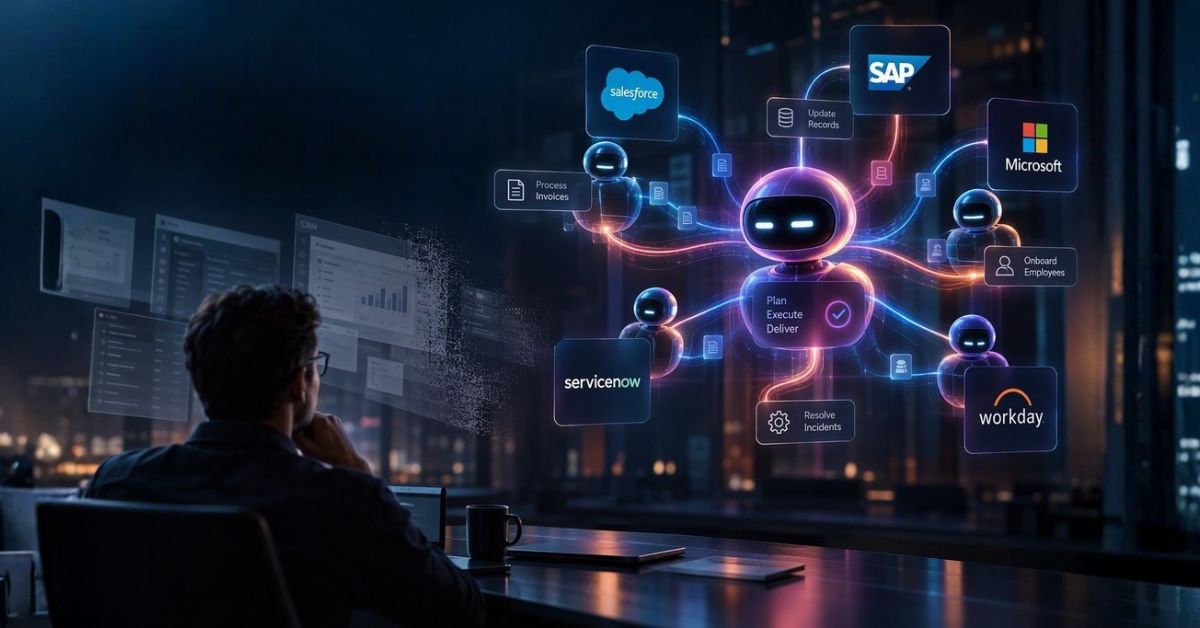
The onboarding journey begins the moment an offer is accepted, not the morning someone walks in. An AI orchestration layer on a platform like OnClik triggers an automated pre-boarding sequence that runs in parallel across every relevant system simultaneously.
Within hours of offer acceptance, the AI agent initiates:
- Identity and access provisioning across the enterprise directory, email system, collaboration tools, and role-specific software, sequenced so credentials are ready before hardware ships
- IT asset coordination matching device specifications to role requirements and flagging orders for dispatch with delivery timed to arrive 48 hours before start date
- HRIS record creation populating fields across payroll, benefits, and compliance systems from a single source of truth
- Document delivery sending offer letters, policy acknowledgments, and tax forms via e-signature workflows with automated follow-up if actions are not completed within defined windows
Week One: Coordinated Immersion
Day one for a new hire should feel like a team is expecting them. With autonomous onboarding, it does.
The AI orchestration layer has already notified the hiring manager, assigned a buddy or mentor, reserved time on relevant colleagues’ calendars, and prepared a structured agenda for the first five days. When the new hire logs in for the first time, their workspace is ready: tools configured, channels joined, relevant documentation surfaced.
Structured check-ins without HR load. The AI Copilot, Cortex in OnClik’s case, conducts short daily check-ins via the employee’s preferred messaging channel. These are not surveys. They are conversational exchanges that surface blockers, answer questions, and flag sentiment patterns that indicate a hire may be struggling.
Adaptive learning path delivery. Rather than assigning the same 12-module compliance course to everyone, the system delivers role-specific, sequenced learning modules at the pace the individual can realistically absorb them in a week that is already information-dense. Completions are tracked and automatically logged in the LMS.
Real-time access gap resolution. When a new hire messages asking for access to a system they need, the AI agent does not just log a ticket. It checks whether access aligns with their role permissions, routes the request to the appropriate approver with context pre-populated, and follows up until resolution occurs. Response time for access requests in autonomous onboarding environments drops from days to hours.
Manager briefings. Each morning, the hiring manager receives a brief from the AI agent: where their new hire is in the onboarding sequence, what they have completed, what is outstanding, and any signals from check-ins that suggest attention is needed. The manager stays informed without needing to chase status.
Weeks Two and Three: Deep Integration
By the second week, a well-designed autonomous onboarding system shifts its focus from logistics to integration. The administrative layer is complete. Now the AI agents are running a different set of processes.
Cross-functional introductions. Based on the hire’s role and the collaborative relationships they will need, the system schedules structured introductions with key stakeholders, briefing both parties beforehand with relevant context.
Benefits and payroll completion monitoring. Benefits enrollment windows are time-sensitive and frequently missed in manual onboarding. The AI agent tracks enrollment status, sends contextual reminders that explain what each benefit option means rather than just asking for a decision, and escalates to HR if the window is approaching without completion.
Policy and compliance training sequencing. Role-specific compliance requirements, data privacy obligations, security protocols, and jurisdiction-specific regulatory training are delivered in a sequenced curriculum with completion deadlines. The system logs every completion, captures acknowledgments, and stores evidence in an auditable format.
Productivity enablement. The AI agent surfaces relevant internal knowledge, documentation, and past projects the hire should be aware of, drawn from the enterprise knowledge base. A new finance analyst on their 12th day does not need to ask where the reconciliation templates live. The system has already surfaced them.
Week Four: Performance Foundation
The final week of structured onboarding is where autonomous systems shift toward outcomes rather than inputs. At day 21, the AI orchestration layer generates a structured onboarding completion report for HR and the hiring manager: every action completed, every milestone hit, compliance status, and a learning completion summary.
Simultaneously, the system initiates a 30-day conversation with the new hire: a structured reflection on their experience, what worked, what was unclear, and what support they still need. This data feeds directly into continuous improvement of the onboarding program itself.
At day 30, probationary check-in workflows are triggered automatically with agenda context pre-populated. Performance expectations that were set in week one are surfaced for review. The hire’s 60-day and 90-day goals are set in the system and tracked from this point forward.
What This Looks Like Across Different Roles
Autonomous onboarding is not a single workflow. It is a dynamic system that adapts to the specific onboarding requirements of different functions.
The Governance Layer: What Humans Actually Control
A reasonable concern about autonomous onboarding is that removing humans from the process removes judgment from it. This misunderstands how agentic orchestration works in a well-designed enterprise platform.
Human oversight is not eliminated. It is elevated to where it actually matters.
HR coordinators move from executing tasks to monitoring outcomes and handling genuine exceptions. The AI agent flags anomalies: a hire who has not completed mandatory compliance training by day 15, an access request that falls outside defined role parameters, a check-in that surfaces a concerning sentiment pattern. These are the moments that require human judgment. Routine sequencing, follow-up, provisioning, and reporting do not.
The Numbers Behind Autonomous Onboarding
The business case for agentic HR onboarding is not abstract. Several measurable outcomes shift significantly when the first 30 days are orchestrated autonomously.
Time to productivity. New hires in structured, well-executed onboarding programs reach full productivity 34% faster than those in informal programs, according to SHRM research. Autonomous orchestration eliminates the delays and gaps that extend the ramp period.
90-day retention. The Society for Human Resource Management estimates that 50% of all hourly workers leave within the first 120 days of employment. Onboarding quality is the primary variable differentiating organizations with low early attrition from those with high early attrition.
HR operational load. A single AI-orchestrated onboarding workflow eliminates an estimated 15 to 20 hours of manual coordination per hire. At scale, this translates directly into HR capacity that can be redirected toward strategic programs.
Compliance completeness. Manual onboarding produces inconsistent compliance completion rates. Autonomous tracking with automated follow-up drives completion rates toward 100% with full audit evidence, a meaningful difference for organizations in regulated industries.
What OnClik’s Autonomous HR Operations Platform Delivers
OnClik UAA was built for exactly this kind of cross-system, multi-step operational orchestration. The HR Onboarding capability within the Intelligent HR Operations suite runs on three core components:
Autonomous Recruitment to Onboarding Handoff. The onboarding journey begins the moment the offer is accepted, with structured handoff from recruitment to HR operations without manual intervention.
AI-Powered Employee Onboarding. Specialist AI agents coordinate access provisioning, document delivery, learning path assignment, check-in cadences, and compliance tracking across every connected enterprise system.
Employee HR Copilot (Cortex). New hires have a natural-language interface for every question they encounter in their first 30 days. Rather than emailing HR or waiting for a response, they ask Cortex and receive an accurate, context-aware answer drawn from enterprise knowledge.
The platform integrates natively with the enterprise systems enterprises already run, meaning deployment does not require ripping out existing infrastructure. It orchestrates across what is already there.
The New Hire Experience, Reimagined
Every enterprise claims to care about employee experience. The evidence is in what actually happens when someone joins.
In a manually coordinated onboarding program, the new hire experience is largely determined by how organized their HR coordinator is, how responsive their manager is, and how lucky they are with timing. In an autonomous onboarding program, it is determined by design.
The first 30 days become a consistent, personalized, proactive experience regardless of which team the hire joins, which office they work in, or which week of the quarter they start. The right information arrives before they need to ask for it. Access is ready when they need it. Questions get answered immediately. Their manager is informed and engaged because the system has done the briefing work.
This is not an incremental improvement on the checklist model. It is a different model entirely, one where AI agents handle the orchestration so that humans can focus on the relationships that actually determine whether a new hire stays, engages, and performs.