Your agent passed every demo. Three weeks into production, nobody can say whether it is working. Latency is fine, error rates are flat, every dashboard is green, and yet an invoice was coded to the wrong cost center and a ticket was closed without being resolved.
Not every cancellation is about monitoring. Gartner also points to hype-driven projects and misapplied use cases. But look at those three reasons again: if you cannot see what an agent did, you cannot price it, prove its value or control its risk. Observability will not rescue a poorly chosen use case, but it is what makes cost, value and risk measurable in the first place.
Why MLOps monitoring falls short
MLOps was built for models that take an input and return a prediction. When that goes wrong you see drift, a drop in accuracy or an outage, and you roll back to a previous version.
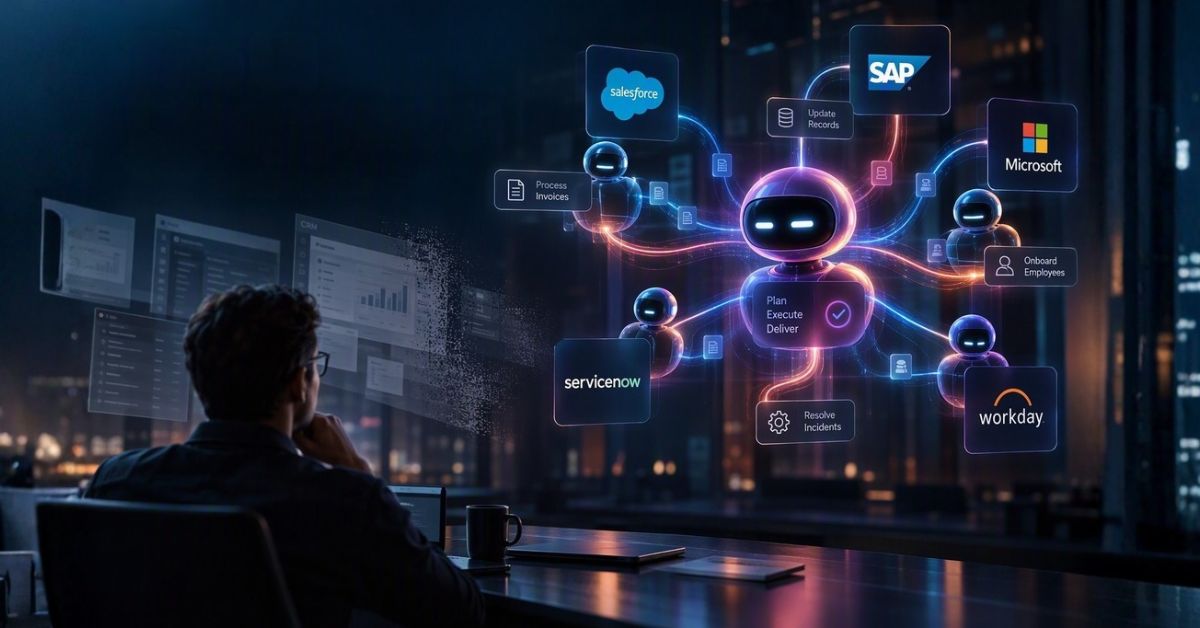
An agent behaves differently. It plans, calls tools, reads the results, retries and hands work to other agents. A single task is a chain of decisions, and the failure is rarely a crash. It is usually a plausible but wrong step early in the run that every later step builds on. Uptime and latency can stay healthy while the outcome is wrong.
The four pillars of agent observability
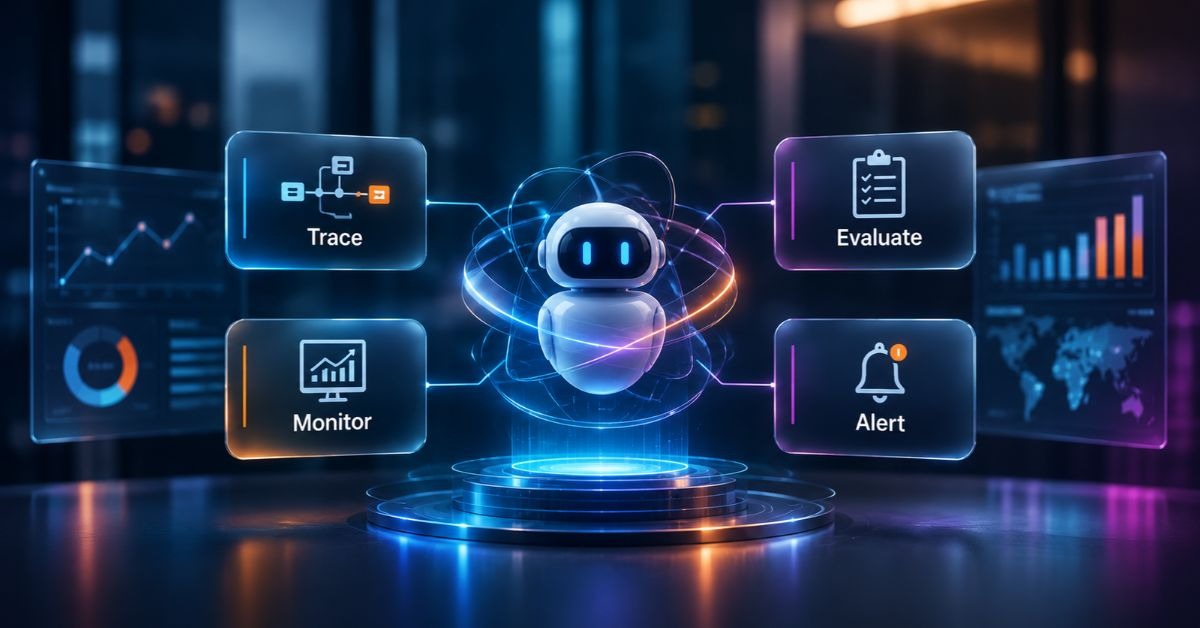
There is no single standard, but a common way to structure agent observability is as four connected capabilities.
Trace. Capture the full decision path of every run: each model call, tool call, input, output and handoff. If you cannot replay a bad run, you cannot fix it.
Evaluate. Score runs against what “good” means for the business, not just whether the task finished. Combine automated checks with sampled human review.
Monitor. Watch quality, cost and risk over time for each agent and workflow. Rising retries, shifts in which tools get called and creeping cost per task are early warnings.
Alert. Tell the right owner when behavior leaves its bounds, then pause the agent, route to a human or stop it.
- 1
Trace
What did it do?Every model and tool call, recorded and replayable. - 2
Evaluate
How well did it do it?Runs scored against business outcomes. - 3
Monitor
Is it still doing it well?Quality, cost and risk tracked over time. - 4
Alert
When did it stop?The right owner is told, and the agent is paused or escalated.
The feedback step is where much of the value lies. When a failed production run becomes a test case, the same mistake is caught before it ships again, and your evaluation set grows from real work instead of guesses.
Cost is an observability metric too
Agent costs often compound as agents take more steps, so token totals can hide what matters. Track cost per resolved task, including every retry and sub-agent step. That single number connects engineering telemetry to business value and helps answer the “unclear value” question before finance asks it.
A checklist before you scale
- Give every agent its own identity and a named, accountable owner.
- Log every tool call with its inputs and outputs, and keep runs replayable.
- Define what “done well” means for each workflow, beyond completion.
- Set thresholds for cost, retries and confidence, and decide in advance what happens when they are crossed.
- Turn every incident into a regression test.
Where OnClik fits
OnClik’s Unified Agentic Automation platform brings together specialist AI agents, processflow orchestration and enterprise-grade governance, and lists monitoring and observability and audit and reporting as cross-cutting capabilities. Treating observability as a platform-level capability, rather than an add-on, is the approach the four pillars above call for.
Build your first OnClik AI agent
See how OnClik’s goal-driven agents run with monitoring, audit and governance.
Talk to an expertSource: Gartner press release, “Gartner Predicts Over 40% of Agentic AI Projects Will Be Canceled by End of 2027,” June 25, 2025.