For distributed enterprises running Oracle E-Business Suite, across dozens of locations, millions of SKUs, and a global supplier base, Oracle EBS remains the operational backbone: the system of record for Finance, Procurement, Manufacturing, Supply Chain, Human Resources, Warehouse Operations, and Customer Service. What it does, it does reliably. What it does not do is decide, orchestrate, or act on its own, and for a CXO weighing the next phase of enterprise transformation, that distinction has become the whole argument.
For a distributed enterprise, that gap shows up everywhere: in the manual review before a purchase order is released, the phone call to confirm an inventory count, the spreadsheet that reconciles a financial close, the customer service agent who has to check three systems before answering one question, the regional HR team re-keying the same onboarding data already sitting in Oracle EBS. None of these steps are a failure of Oracle EBS. They are the cost of running a transactional system without an intelligence layer above it.
That cost used to be an operating detail, absorbed into headcount and quietly budgeted around. It is now a strategic one. Competitors who close this gap first move faster on procurement decisions, spot supply chain disruptions before they cascade, and answer customers in one interaction instead of three. The talent required to keep manual reconciliation running is getting harder and more expensive to hire. And every audit, every regulatory filing, and every board question about operational resilience now implicitly asks how much of the business still depends on someone remembering to do a manual step correctly.
The CXO Decision: Replace the ERP, or Make It Intelligent
Modernizing Oracle EBS is on most CXO agendas, but the framing is usually binary: replace the ERP, or live with its limits. Both options carry real cost. A multi-year replacement program disrupts operations, ties up capital, and puts institutional process knowledge at risk during the transition. Living with the status quo means every quarter of growth adds more manual handoffs, more headcount tied to reconciliation work, and more distance between the data in the system and the decisions being made from it.
Weighed properly, the decision comes down to three lenses that matter to any CXO: capital exposure, operational risk, and time to value. A replacement program concentrates all three in the worst possible way, a large committed spend, years of dual-running risk during cutover, and value that only arrives once the new system is fully live. An AI Agentic Layer inverts all three. The capital commitment is incremental rather than committed up front, the operational risk is contained because Oracle EBS never stops running the transactions it already runs, and value shows up with the first workflow it automates, not the last.
There is a third option gaining ground with enterprises that cannot afford either extreme: keep Oracle EBS as the system of record, and add an AI Agentic Layer that makes its transactions autonomous, intelligent, and conversational, without replacing the system underneath.
OnClik UAA: an AI Agentic Layer, Not a Replacement
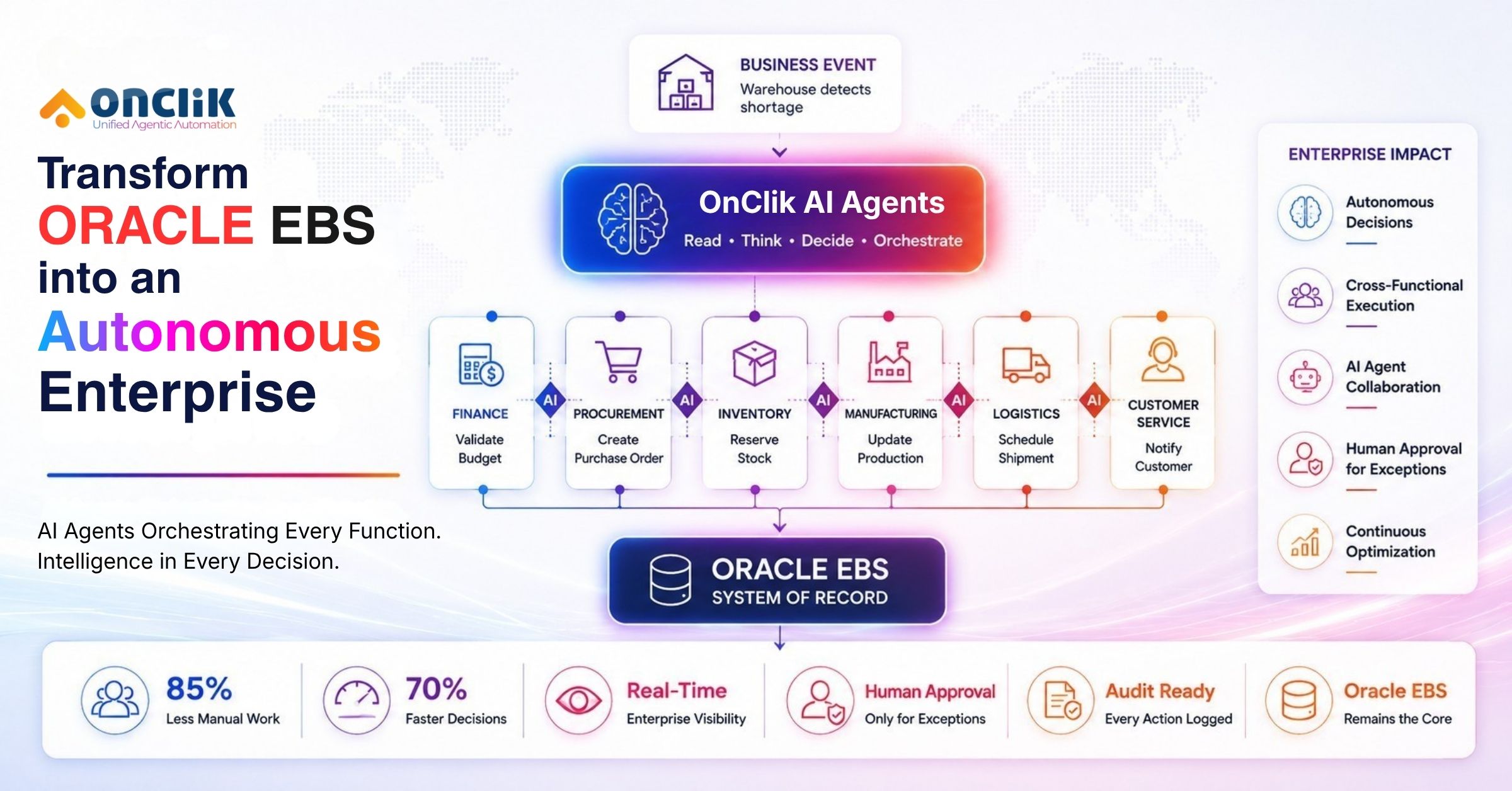
OnClik Unified Agentic Automation (UAA) sits on top of Oracle EBS rather than inside it. Oracle EBS continues to manage transactions exactly as it does today. OnClik UAA adds the capability to act on those transactions: interpreting a request, orchestrating the steps across systems and teams, applying judgment where the data allows it, and routing the exceptions that genuinely need a person.
That capability is built from seven components working together: AI Agents that execute defined tasks, Workflow Orchestration that sequences work across departments, native Oracle EBS Integration, an Enterprise Knowledge layer that gives agents the organizational context to act correctly, Human-in-the-Loop controls for judgment calls and exceptions, AI Analytics that surface patterns as they emerge, and Conversational AI that lets employees and customers interact with the system in plain language instead of navigating screens.
The same architecture principle extends beyond Oracle EBS itself. Enterprises accumulate point solutions over time: one tool for approvals, another for reporting, another for case management, each solving a narrow problem while adding a new integration to secure and maintain. Because the AI Agentic Layer is ERP-agnostic by design, it gives CXOs a way to consolidate that sprawl into a single orchestration layer, rather than adding one more disconnected tool to an already crowded stack.
Where Oracle EBS manages transactions, OnClik UAA makes those transactions autonomous, intelligent, and conversational.
Why Orchestration Beats Isolated Automation
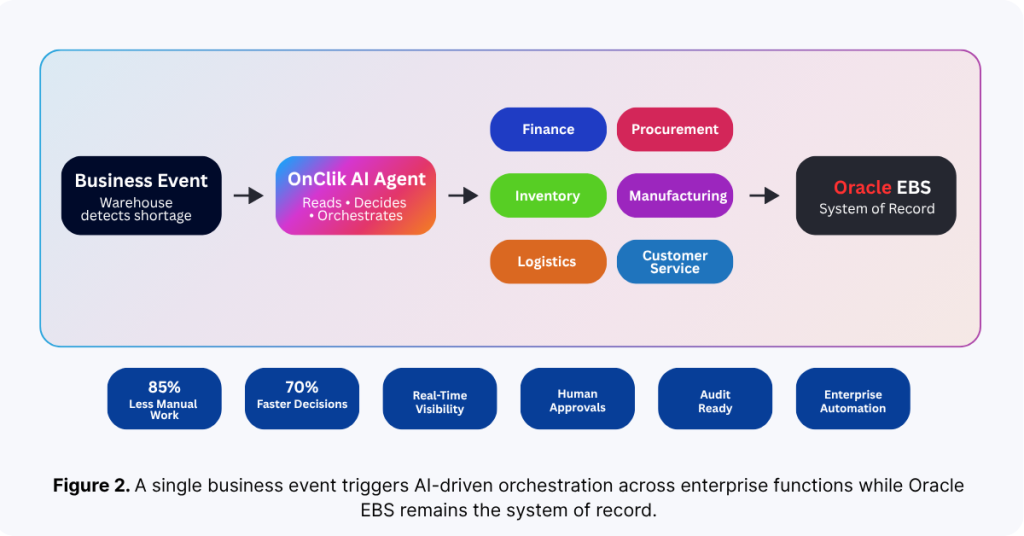
It is possible to automate a single task, such as auto-approving a low-value purchase order, and see a small, isolated gain. But in a distributed enterprise, that is rarely where the cost sits. A stock shortage in one warehouse is a procurement decision, a finance commitment, a logistics reroute, and, eventually, a customer service conversation. When each of those functions is automated separately, the bottleneck simply moves to the handoff between them.
The greater value for a distributed enterprise comes from orchestrating AI agents across Finance, Procurement, Manufacturing, Supply Chain Management, Human Resources, Warehouse Operations, and Customer Service as a single connected process, not seven disconnected ones. OnClik UAA is built for that orchestration: a single business event triggers coordinated action across every function it touches, with Oracle EBS as the record of what happened at each step.
This is also where isolated pilots tend to plateau. A single automated task delivers a bounded, one-time gain and then stops compounding. An orchestration layer behaves differently: every additional function connected to it increases the value of the functions already live, because the handoffs between them, not just the tasks within them, are now coordinated automatically. The return on the fourth or fifth function connected is often larger than the return on the first, simply because more of the handoff chain is now covered.
What This Looks Like in Practice
Procure-to-pay. When a warehouse falls below its reorder threshold, an AI Agent raises the purchase requisition, checks it against contracted pricing already recorded in Oracle EBS, and routes it through Workflow Orchestration to the right approver only if it exceeds a defined threshold. Below that threshold, the agent releases the order itself and posts the transaction back to Oracle EBS, with the full trail available for audit.
Financial close. Enterprise Knowledge gives agents the context to reconcile routine variances, flag anomalies against prior periods, and prepare the supporting schedules finance teams currently build by hand. Human-in-the-Loop keeps the close owned by the controller’s team; the agents remove the manual assembly work, not the review.
Customer service exceptions. Conversational AI lets a customer or field technician ask about an order status in plain language. Where the answer requires checking inventory, a shipment, and a warranty record across three modules of Oracle EBS, the agent retrieves and reconciles all three in the background and responds in a single interaction, rather than transferring the request between departments.
Each of these examples touches a different part of the organization, but they share the same pattern: Oracle EBS holds the transaction, and OnClik UAA decides what needs to happen next, who needs to be involved, and when a person should be brought in rather than an agent.
What Changes for the Business
- Operational efficiency Fewer manual handoffs between Procurement, Inventory, and Finance means transactions move at the speed the business needs, not the speed of the slowest manual step.
- Decision velocity AI Analytics and Enterprise Knowledge give leadership and frontline teams the same real-time view, so decisions happen at the point of need rather than at the next scheduled review.
- Customer experience Conversational AI and cross-functional orchestration let customer-facing teams resolve a request in one interaction, instead of routing it across departments and systems.
- Governed autonomy Human-in-the-Loop is a design principle, not a fallback. Agents handle the transactional and repetitive work; people retain control over judgment calls, exceptions, and strategic decisions.
- Vendor and tool consolidation An ERP-agnostic orchestration layer reduces the number of disconnected point solutions the organization has to license, secure, and maintain over time.
Governance, Security, and Trust in the Agentic Layer
Autonomy is only useful to a CXO if it is governed. Human-in-the-Loop is not a caveat added after the fact; it is a control point designed into the architecture from the start. Every threshold, every routing rule, and every exception path is configurable by the business, not fixed by the platform, so the organization decides where an agent acts on its own and where a person signs off first.
Because Oracle EBS remains the system of record, every action an AI Agent takes is posted back into the same ledger the organization already audits, secures, and reports from. There is no shadow system holding transactions the finance or compliance team cannot see. Access follows the roles and controls already defined in Oracle EBS, so the agentic layer inherits governance rather than duplicating it, and the audit trail a CXO relies on today does not change shape as autonomy increases.
A Phased Path to Autonomous Operations
Enterprises do not need to adopt an AI Agentic Layer all at once. The organizations seeing the fastest return start with a single high-friction workflow, often in procurement or customer service, prove the orchestration and governance model in production, and expand function by function from there. Each new function added to the layer increases the value of the ones already live, because the orchestration connecting Procurement to Finance to Customer Service compounds with every additional process it touches.
That pilot-to-production path is deliberate. It gives a CXO a working, governed example inside their own Oracle EBS environment before asking the board to underwrite anything larger, and it means the case for expanding the agentic layer is made with the organization’s own data, not a vendor’s projections.
Distributed enterprises running Oracle EBS do not need to choose between the ERP they have and the autonomy they need. OnClik UAA makes both possible at the same time, starting with a single workflow and expanding at the pace the business is ready for.
OnClik Unified Agentic Automation · The AI Agentic Layer for Oracle EBS ·