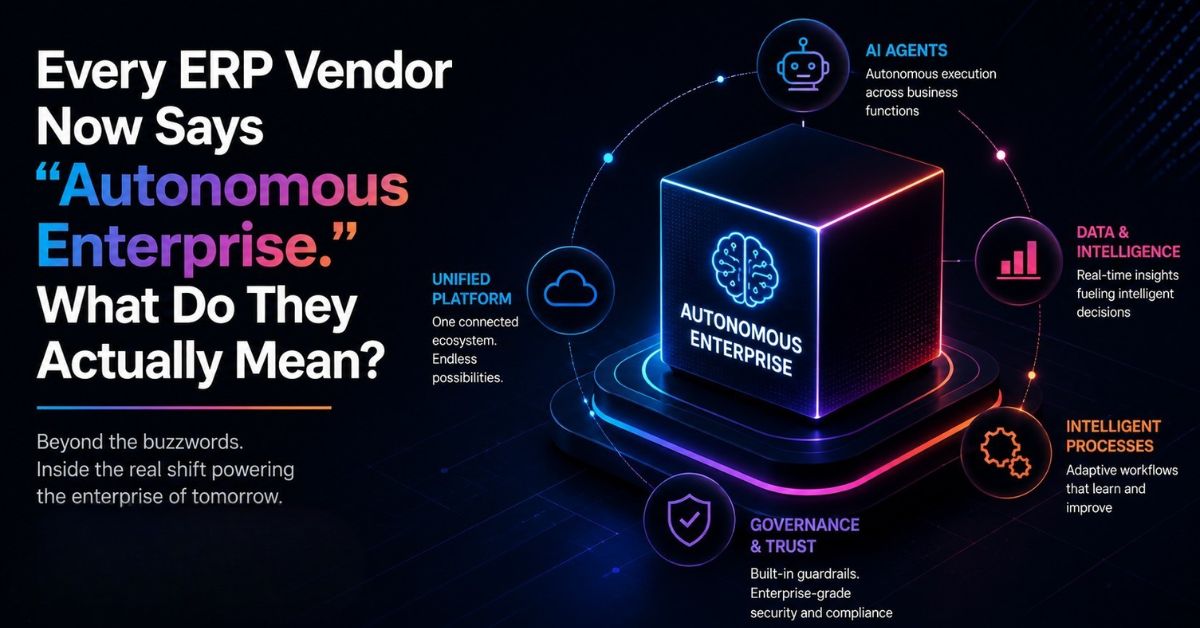
In the space of about a year, “autonomous enterprise” went from a slide-deck flourish to the official name of at least one major platform pivot, the working description of another, and the marketing shorthand for a third. If you’re a CIO or CFO sitting through vendor pitches this quarter, you’ve probably heard some version of the phrase three times this month alone. What almost nobody says out loud is that the three biggest vendors using it mean structurally different things.
That gap matters more than it sounds. Two platforms can both claim to run an “autonomous enterprise” while placing the agent layer, the audit trail, and the actual point of control in completely different places. For a buyer, that’s not a branding nuance. It’s the difference between an architecture decision you can live with for five years and one you’ll be renegotiating out of in eighteen months.
What SAP means
At Sapphire 2026, SAP made the clearest version of this claim of any vendor: it renamed its own platform ambition the Autonomous Enterprise and framed the shift as the difference between being a software company and becoming, in CEO Christian Klein’s words on stage, a business AI company. The centerpiece is Joule Studio, SAP’s agent builder, which went generally available in the first quarter of 2026. By the following quarter SAP was running upward of 40 domain-specific Joule agents across finance, supply chain, procurement, HR, and customer experience, and by June, Joule Studio 2.0 had expanded that further, with roughly 200 specialized agents beginning rollout across SAP’s customer base.
SAP’s pitch to CIOs is that a governed outcome arrives faster because SAP’s own process knowledge, semantics, and enterprise controls are already built into the platform the agents run on. That’s a real advantage for a company that runs entirely on SAP. It’s also, by design, the mechanism that makes Joule Studio the default control plane for agent orchestration, which keeps customers and partners building on SAP’s own infrastructure rather than a neutral one. Fewer seams inside the SAP world. Fewer options for anything that isn’t SAP.
What Oracle means
Oracle didn’t adopt the identical phrase, but its Fusion Agentic Applications push, announced in April 2026 and expanded again in June, is making the same underlying argument. Twelve agentic applications shipped first, embedded directly into Oracle Fusion Cloud ERP and Supply Chain & Manufacturing, covering functions like claims settlement and sourcing negotiation. Four more followed in June for warehouse and inventory operations. Every one of them runs inside Oracle’s existing security framework, approval hierarchies, and permissions, rather than as a layer bolted on top.
The trade Oracle is making has the same shape as SAP’s. In exchange for staying inside Oracle’s stack, an enterprise gets domain-specific logic, tuned to supply chain and finance workflows, that a generic agent platform can’t replicate without months of custom build. What it doesn’t get is a vendor-neutral automation layer. The depth is real. So is the dependency.
What Salesforce, and the connective-layer players, mean
Salesforce took a different route into the same territory. Rather than embed agents inside an ERP core it doesn’t own, it extended Agentforce outward across systems and coined its own term for the destination: the agentic enterprise, where agents complete entire workflows rather than draft suggestions for a human to approve. Agentforce Operations, launched in April 2026, specifically targets back-office work spanning email, CRM, and ERP, with Salesforce citing cycle-time reductions of up to 70% and an 80% drop in manual tasks in its own reported deploymentsVendor-reported.
ServiceNow pushed this logic even further. Instead of competing as an ERP alternative, its 2026 platform release added thirty new integrations spanning AWS, Google Cloud, Azure, SAP, Oracle, and Workday, positioning itself as the connective layer that grounds agent decisions across a multi-vendor ERP environment rather than inside any single one of them. That’s a meaningfully different bet than SAP’s or Oracle’s: don’t own the core, own the connections between everyone else’s.
Same phrase, three different places for the agent layer to live. SAP and Oracle build autonomy into their own stack. Salesforce and ServiceNow orchestrate across everyone else’s.
The thread underneath the branding
Strip the branding away and every one of these claims is answering the same underlying question: who governs the agent, and what happens the day it’s wrong. That’s where the industry’s own data gets uncomfortable, regardless of which vendor’s architecture you’re looking at.
Gravitee’s State of AI Agent Security 2026 report, based on a survey of more than 900 executives and technical practitioners, found that 88% of organizations had experienced a confirmed or suspected AI agent security incident in the past twelve months. Eighty-two percent of executives said they were confident their existing policies protected them from unauthorized agent actions. Only 21% actually had runtime visibility into what their agents were accessing, which tools they were calling, or what data they were touching. Just 14.4% of agents currently in production went live with full security and IT sign-off.
None of this is specific to one vendor’s architecture. It’s the structural gap every autonomous enterprise claim has to answer for, and most vendor marketing doesn’t.
What to actually ask a vendor claiming this
In December 2025, OWASP published a dedicated Top 10 for Agentic Applications, built with more than 100 security practitioners, specifically because autonomous agents introduce risk categories that traditional application security was never built to catch. Whatever platform is on the table, the useful questions aren’t about how many agents it ships. They’re about the architecture underneath the claim.
- 1Does every agent carry its own identity, or does a fleet of agents share one credential the way many production deployments still do today?
- 2Is tool and data access scoped to least privilege by default, or granted broadly and trimmed later?
- 3Is there a continuous, queryable audit trail, or a periodic review that only surfaces problems after the fact?
- 4Can someone outside the vendor’s own team see what an agent actually did, not just what it was authorized to do?
- 5What happens to that governance model the day you add a second vendor’s agents into the same workflow?
That last question is usually the one vendor demos skip, because for a platform built to govern its own agents inside its own stack, the honest answer is: not much.
Where a unified layer changes the calculus
The pattern across SAP, Oracle, and Salesforce is that each is building autonomy as a feature of its own platform. That’s a reasonable strategy for a vendor defending an existing footprint. It’s a harder proposition for an enterprise running more than one of these systems at once, which is most enterprises evaluating this today.
A governance layer that sits above the stack, rather than inside any single vendor’s version of it, does two things at once. Every agent gets the same identity model, the same permissioning, and the same audit trail, regardless of which underlying system it touches. And the choice of ERP, CRM, or ITSM vendor stops also being the choice of who owns your automation roadmap.
That’s the model behind OnClik’s Unified Agentic Automation platform. Specialist agents and Cortex orchestration connect natively into SAP, Oracle, Salesforce, Workday, and ServiceNow, governed through one control layer your team owns, not whichever vendor’s stack the agent happens to be running inside.
Sources
- SAP News Center, “SAP Unveils the Autonomous Enterprise,” May 2026.
- ERP Today, “SAP Sapphire 2026 Keynote: Inside SAP’s Autonomous Suite and the Move to Business AI,” May 2026.
- Enterprise DNA, “SAP Bets the Company on AI Agents at Sapphire 2026,” May 2026.
- SaaS News, “SAP Launches Joule Studio 2.0 with 200 AI Agents,” June 2026.
- Oracle News Center, “Oracle Introduces Fusion Agentic Applications for Finance and Supply Chain,” April 2026.
- The D*AI*LY Brief, “Oracle’s 4 AI Agents Now Autonomously Run Your Supply Chain,” June 2026.
- Salesforce AP, “What Is the Agentic Enterprise?,” 2026; Salesforce Newsroom, “Salesforce Launches Agentforce Operations,” April 2026.
- Gravitee, “State of AI Agent Security 2026 Report: When Adoption Outpaces Control.”
- VentureBeat, “The Enforcement Gap: 88% of Enterprises Reported AI Agent Security Incidents Last Year,” April 2026.
- OWASP GenAI Security Project, “OWASP Top 10 for Agentic Applications 2026,” December 2025.
See governance that isn’t tied to one vendor’s stack
OnClik’s Unified Agentic Automation platform connects natively into SAP, Oracle, Salesforce, Workday, and ServiceNow, governed through a single control layer your team owns.
Book a demo