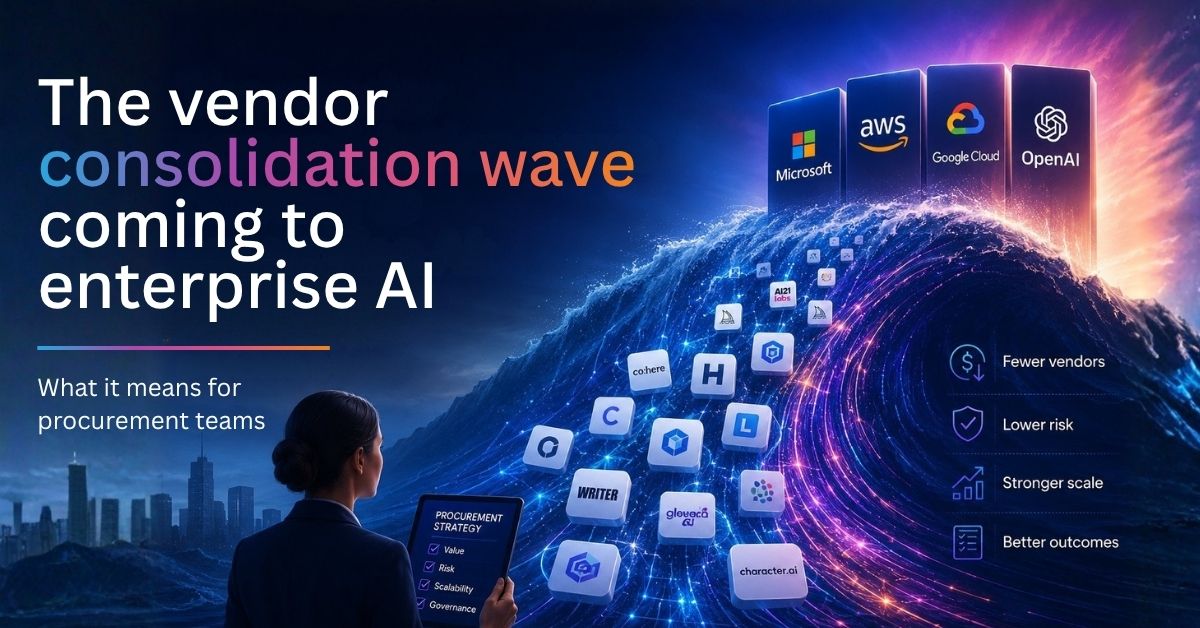
For most of the last two years, enterprise AI procurement had a simple pattern: a new use case appeared, a department found a point solution, and finance signed off on another line item. That pattern is breaking. AI infrastructure spending alone is projected to reach 487 billion dollars in 2026, more than three times what it was just two years earlier, and yet the number of vendors collecting that spend per enterprise is shrinking. Procurement teams are being asked to do something they have not done before: negotiate for a platform that will still make sense in three years, not just a tool that solves this quarter’s problem.
What is actually driving the consolidation
Three forces are pushing in the same direction at once. First, capital is concentrating hard at the model layer. OpenAI closed the largest private funding round in history in March 2026, 122 billion dollars in committed capital at an 852 billion dollar valuation, backed by Amazon, Nvidia, SoftBank, and Microsoft. That kind of capital concentration at the top of the stack tends to produce fewer credible long term suppliers over time, not more. Second, the hyperscalers have stopped treating AI as an add on and started bundling it. Model access, orchestration, vector search, and governance are increasingly sold as a single SKU rather than four separate contracts, which is exactly what CIOs have been asking procurement to find for two years. Third, and most relevant to procurement specifically, the pilot era left a mess. MIT’s 2025 State of AI in Business research found that the large majority of generative AI pilots never produce a measurable financial return, and McKinsey’s 2025 State of AI survey found that 88 percent of agent pilots never make it to production, with evaluation gaps, governance friction, and model reliability named as the leading blockers. What is left behind in procurement’s inbox is a long tail of half adopted tools that nobody wants to keep renewing.
Put together, this is not a temporary budget correction. It is a structural shift in how enterprise software gets bought, and it changes what procurement should be asking for.
IDC projects global AI infrastructure spending will reach 487 billion dollars in 2026, up from 153 billion just two years earlier, even as enterprises narrow the number of vendors they pay to deliver it.
Directional trend, illustrative. Spend figures per IDC Worldwide AI Infrastructure Tracker, 2026.
What is actually consolidating is not the logos, it is the layers
It is tempting to read vendor consolidation as a story about fewer brands on a slide. The more useful way to see it is by layer. Four capabilities that enterprises used to buy from four different places, model access, agent orchestration, data and governance, and security, are increasingly delivered from one control plane. That does not mean one vendor will own every layer forever. It means the winning platforms are the ones architected so those layers work together natively, instead of being stitched together after the fact through custom integration work that IT ends up owning.
The consolidation wave is really a story about layers merging into a single architecture, not just fewer logos on a vendor list.
The scorecard procurement used in 2023 is already out of date
Most AI vendor evaluations built over the last two years were designed for a world of point solutions: compare feature lists, compare price per seat, pick the strongest demo. That scorecard does not tell you much about a platform decision, because the risks that matter now show up after the contract is signed, in integration cost, in switching cost, and in whether the vendor can produce an audit trail when a regulator or a board asks for one.
The individual criteria matter less than the shift in what they are measuring: not whether the tool works in a demo, but what it costs to keep, integrate, and prove compliant once it is running at scale.
What procurement teams should change now
- Rewrite the RFP around architecture, not features. Ask where data lives, which layers can be swapped without a re-implementation project, and what the exit looks like at renewal.
- Run a two tier vendor strategy. A small number of strategic platform vendors carry the scaled workloads. A controlled sandbox, with clear guardrails, allows the business to keep experimenting at the edge without adding permanent contracts.
- Ask for evidence of production use, not pilot success. Given how many agent pilots stall before reaching production, a vendor’s own case studies should show live deployments at comparable scale, not proof of concept results.
- Treat audit trails and governance documentation as table stakes. If a vendor cannot show how a decision an agent made can be reconstructed after the fact, that is a governance gap procurement should be pricing into the deal, not discovering during an incident.
- Model cost over three years, not the first invoice. Consumption based pricing, integration labor, and the cost of running two systems during a migration all belong in the same total cost of ownership model.
- Bring IT, finance, legal, and the business unit into one evaluation. Sequential sign offs are how enterprises ended up with the tool sprawl they are now trying to unwind.
The goal is not the smallest possible vendor list. It is an architecture that stays open at the model layer while closing the integration and governance gaps that made the last generation of AI tools expensive to run.
The risk on the other side of consolidation
It is worth naming the failure mode procurement teams should watch for. Consolidating too fast, or consolidating around a single model provider rather than a platform architecture, simply trades one problem for another. Tool sprawl becomes vendor lock-in, and lock-in shows up years later as a renegotiation with no leverage. The enterprises getting this right are not the ones with the fewest vendors on paper. They are the ones that separated the orchestration layer from the model layer deliberately, so that switching a model provider is a configuration change rather than a rebuild. That distinction, architected for flexibility versus consolidated by default, is the question worth spending the most diligence time on in any platform evaluation this year.
The vendor landscape enterprise AI buyers are navigating in 2026 looks less like a shopping list and more like an infrastructure decision, and infrastructure decisions are procurement’s business to get right. Platforms built from the ground up to unify orchestration, governance, and execution across the systems an enterprise already runs, rather than bundling acquisitions together after the fact, are the ones worth the closest look at renewal time.