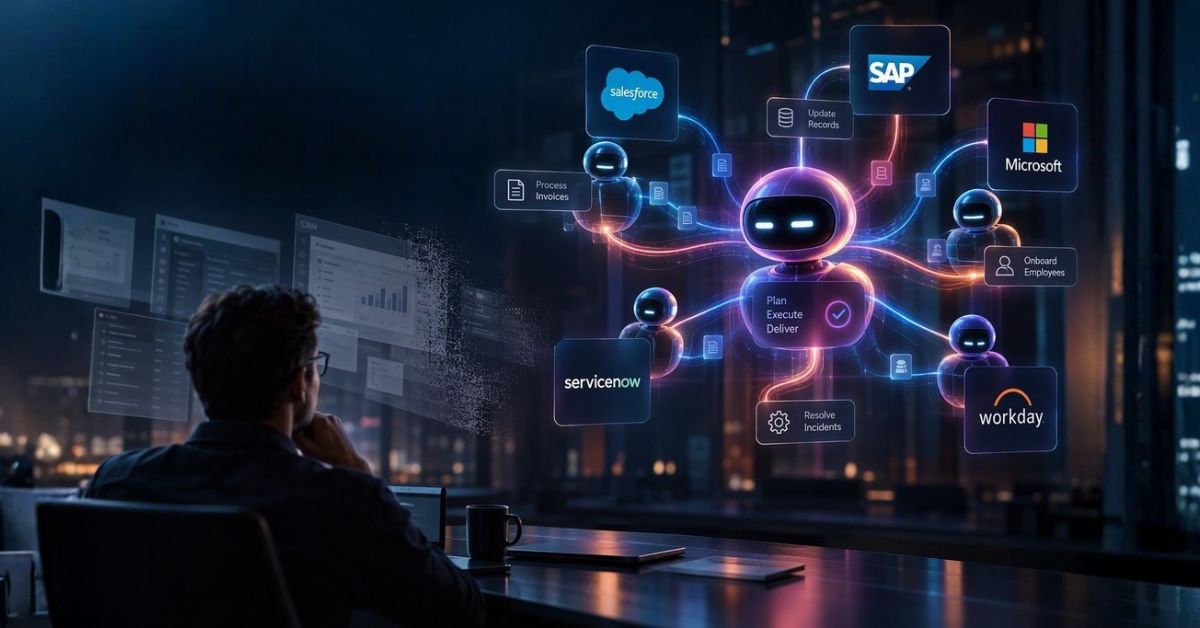
For years, enterprise automation focused on repetitive tasks and predefined workflows. Today, AI agents are introducing a different model. Instead of simply following rules, they can understand goals, make decisions within defined boundaries, interact with multiple systems, and execute multi-step processes.
However, it is important to separate reality from hype. Most enterprises are not deploying fully autonomous organizations. The most successful implementations focus on specific business functions where AI agents can operate within clear guardrails and human oversight. Recent industry research shows that organizations are increasingly embedding AI agents into core workflows rather than using them only as productivity tools.
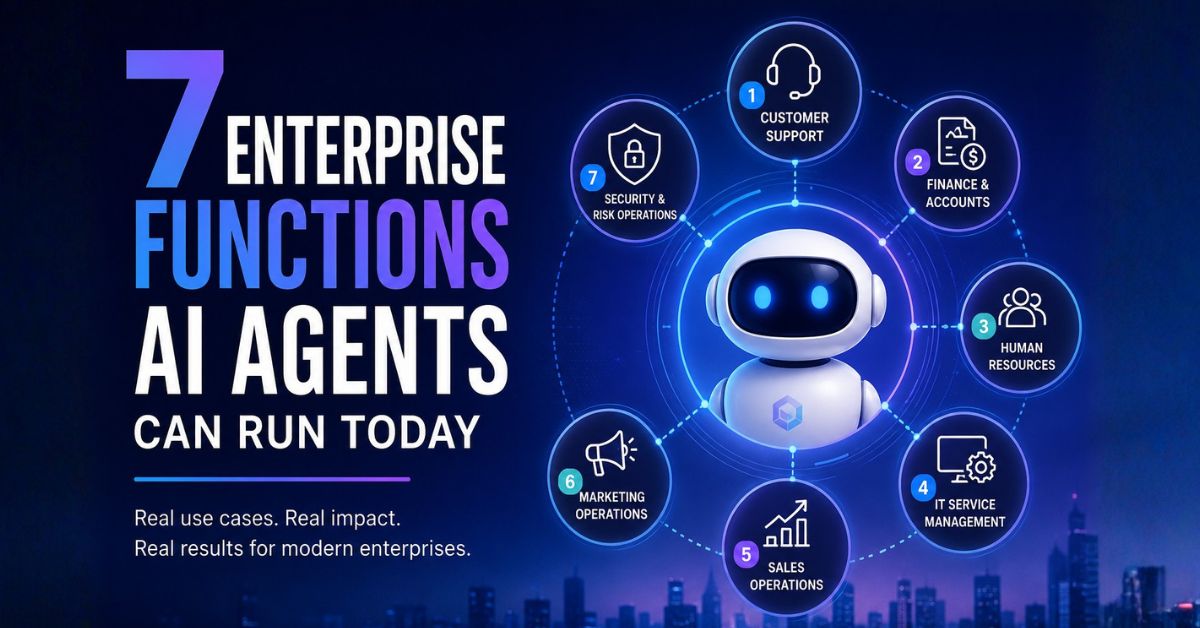
Here are seven enterprise functions where AI agents are delivering real operational value today.
1. Customer Support Operations
Customer support remains one of the most mature areas for AI agents.
Modern support agents can:
- Classify and prioritize tickets
- Route requests to the correct teams
- Retrieve knowledge articles
- Generate responses
- Escalate complex issues
- Follow up with customers
Unlike traditional chatbots, AI agents can evaluate context, sentiment, urgency, and previous interactions before taking action.
Several enterprise platforms are now deploying autonomous support agents across chat, email, messaging channels, and internal collaboration tools. Customer service continues to be one of the fastest-return AI use cases.
2. Finance and Accounts Operations
Finance teams spend significant time on repetitive activities such as:
- Invoice processing
- Expense validation
- Reconciliation
- Exception handling
- Approval routing
- Month-end closing support
AI agents can collect information from multiple systems, identify anomalies, request missing documents, and escalate unusual transactions for human review.
Research into governed agentic systems for back-office finance operations shows promising results, particularly when agents operate within defined policies and audit controls.
3. Human Resources and Employee Onboarding
HR departments increasingly use AI agents to support employee experiences.
Typical responsibilities include:
- Coordinating onboarding activities
- Answering policy questions
- Scheduling training sessions
- Collecting required documents
- Managing employee requests
- Guiding offboarding processes
These agents help reduce administrative workload while providing employees with immediate support.
Industry examples show HR as one of the leading functions for AI agent adoption because processes are often standardized and highly repetitive.
4. IT Service Management
IT operations generate thousands of repetitive requests, including:
- Password resets
- Access requests
- Ticket classification
- Incident triage
- Software installation
- System diagnostics
AI agents can gather system information, execute predefined remediation steps, verify outcomes, and update tickets automatically.
Many organizations are using agents as first-line IT operators, while human teams handle complex incidents and high-risk decisions.
5. Sales Operations
Sales teams spend considerable time on administrative work rather than selling.
AI agents can:
- Research prospects
- Enrich CRM records
- Schedule meetings
- Generate follow-up emails
- Qualify leads
- Update pipeline information
Recent enterprise AI platforms increasingly target sales functions because they combine large amounts of structured and unstructured information.
6. Marketing Operations
Marketing teams manage numerous repetitive processes across multiple systems.
AI agents can assist with:
- Campaign coordination
- Content generation
- Performance reporting
- Audience segmentation
- Asset management
- Workflow approvals
Several organizations report significant reductions in campaign execution time through AI-driven marketing workflows integrated with enterprise systems.
7. Security and Risk Operations
Security teams face growing volumes of alerts and incidents.
AI agents can:
- Monitor alerts
- Correlate events
- Prioritize risks
- Gather context
- Recommend actions
- Trigger approved responses
Research in security operations centers demonstrates that agentic systems can improve alert triage and help security teams respond faster while maintaining human oversight.
What AI Agents Cannot Reliably Run Yet
Despite rapid progress, AI agents still struggle with:
- High-stakes executive decisions
- Complex negotiations
- Legal accountability
- Strategic planning
- Ambiguous situations with limited data
- Major organizational changes
Industry experts consistently emphasize that today’s successful deployments focus on well-defined processes with clear rules, measurable outcomes, and human oversight. Narrow operational use cases often produce the highest return on investment.
The Future Is Not Full Autonomy
The most successful enterprises are not replacing entire departments with AI agents. Instead, they are creating hybrid work models where humans focus on judgment, relationships, creativity, and strategy while AI agents handle repetitive operational work.
The goal is not autonomous organizations. The goal is autonomous workflows.
Organizations that begin with focused, governed use cases in customer service, finance, HR, IT, sales, marketing, and security are likely to see the fastest and most measurable business value from AI agents.